
In April 2026, Anthropic announced Claude Mythos Preview, a new general-purpose frontier model. According to Anthropic, the model performs strongly across many tasks, but is especially capable in cybersecurity: not only finding vulnerabilities, but also chaining them into working exploits.
Rather than making Claude Mythos Preview broadly available, Anthropic launched Project Glasswing, giving access to selected partners and critical software organisations for defensive security work. This limited rollout also contributed to the hype around the model. By restricting access, involving major industry partners and framing Mythos Preview as unusually capable in offensive security contexts, Anthropic created a sense of urgency before much independent evidence was available.
As Anthropic also offered access to Claude Mythos to open source projects through the Linux Foundation. Claude Mythos preview was able to scan curl, a CLI tool used to transfer data. curl is also libcurl, used in cars, television sets, routers, printers, audio equipment, mobile phones, tablets, medical devices, set-top boxes, computer games, media players and is the internet transfer engine for countless software applications in over twenty billion installations. curl is used daily by virtually every Internet-using human on the globe.
The results of this scan are underwhelming to say the least, but nonetheless very interesting. Even though curl is one of the most fuzzed and audited C codebases in existence Claude Mythos preview reported that it found 5 confirmed security vulnerabilities. But the curl team reduced that to one confirmed low-severity vulnerability; three were false positives and one was “just a bug.”
Anthropic also reported that Claude Mythos preview found a critical vulnerability in OpenBSD. This involved chaining two bugs to create a denial of service attack. Which would allow the attacker to repeatedly crash machines running a vulnerable service.
So is Claude Mythos preview objectively better at finding vulnerabilities in comparison to previous models? We can’t answer that for sure as most of the findings are not disclosed as of writing. One source we have comes from CyberGym, a cybersecurity benchmark tool developed by UC Berkeley that assesses the capabilities of AI agents on real-world vulnerability analysis tasks. On CyberGym Level 1, which measures whether an agent can reproduce known vulnerabilities with working PoCs, Mythos Preview is reported at 83.1%, compared with GPT‑5.5 at 81.8%. That is a small lead on this benchmark, but it does not prove that Mythos is objectively better at all forms of vulnerability discovery or exploit development.
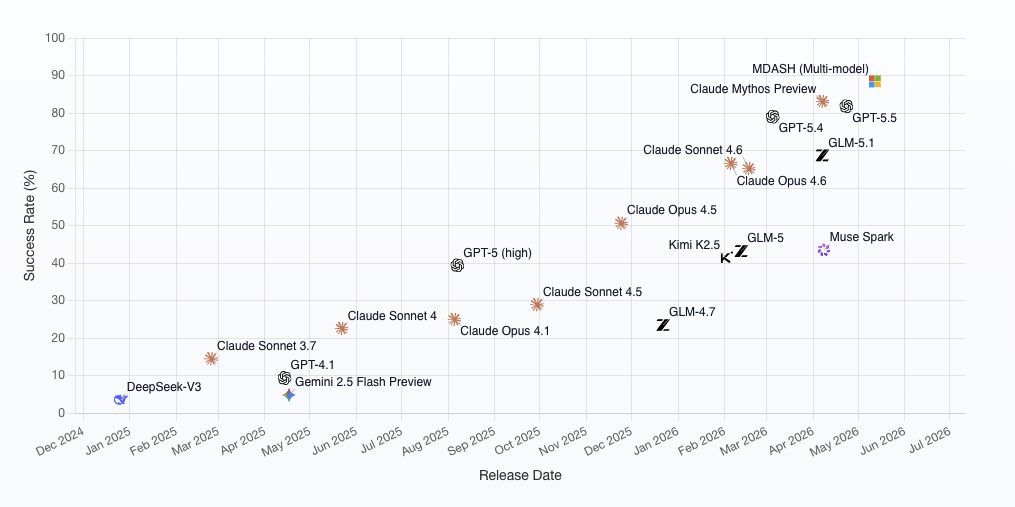
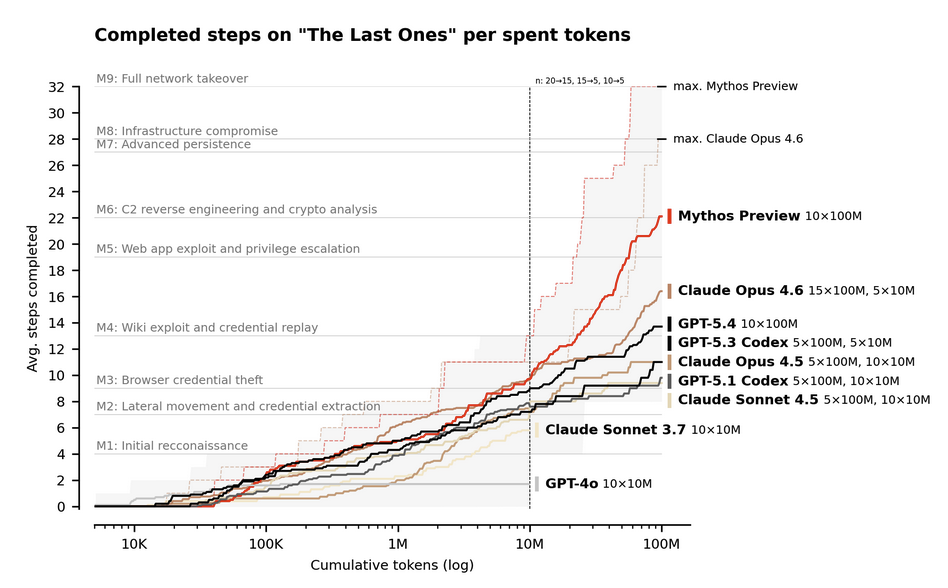
So is Claude Mythos Preview better at writing exploits? According to Anthropic, the model’s ability to chain multiple vulnerabilities together into a working attack is what makes it especially dangerous. The AI Security Institute is a research organisation within the Department for Science, Innovation and Technology within the UK government. By benchmarking Mythos on a 32-step corporate network attack simulation they found that Claude Mythos preview did perform better than any other model AISI tested on this benchmark. There are some caveats though, while Claude Mythos preview does show that it is at least capable of autonomously attacking small, weakly defended and vulnerable enterprise systems the success rate seems to scale with the token budget. There were important differences from real-world environments, the tested network lacked security features that are often present, such as active defenders and defensive tooling. There were no penalties for the model for undertaking actions that would trigger security alerts.
So what does a model like Claude Mythos preview change? The speed of discovery of a bug goes up, this means the gap between when an attacker discovers a vulnerability and when defenders find out about it increases. Secondly the exploit volume and adaptation goes up. A frontier model can produce thousands of variations of a single exploit allowing an attacker to run reconnaissance at a lager scale.
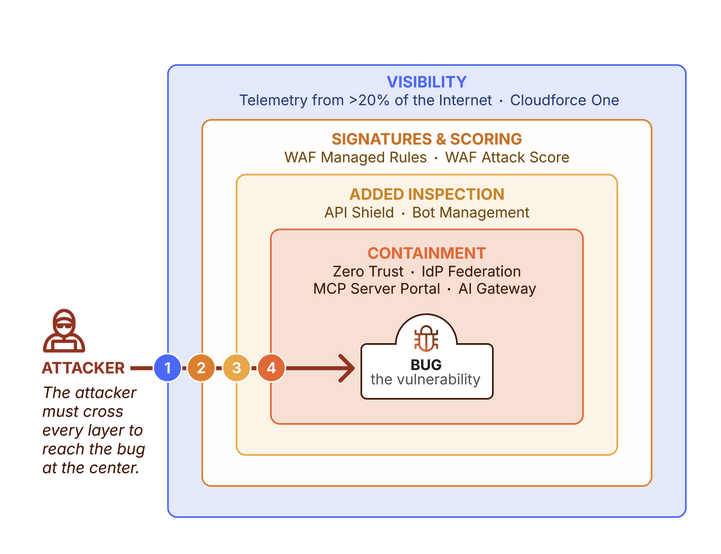
We do not think Mythos will cause a cybersecurity apocalypse, but it is difficult to ignore that frontier models are becoming highly capable at cybersecurity-related tasks. The main change is speed and scale: they can help attackers find vulnerabilities faster, generate exploit variants, and adapt payloads. The practical defensive response is not to assume every bug can be patched before exploitation, but to reduce blast radius through layered defences, validated API traffic, bot detection, identity-based access controls, AI gateways, approved MCP connections, and comprehensive logging.
Sources:
- https://red.anthropic.com/2026/mythos-preview/
- https://www.anthropic.com/glasswing
- https://curl.se/
- https://daniel.haxx.se/blog/2026/05/11/mythos-finds-a-curl-vulnerability/
- https://www.cybergym.io/cybergym/
- https://www.aisi.gov.uk/blog/our-evaluation-of-claude-mythos-previews-cyber-capabilities
- https://arxiv.org/abs/2603.11214
- https://blog.cloudflare.com/cyber-frontier-models/
- https://blog.cloudflare.com/frontier-model-defense/